If you follow new anime, you've seen people talk about "the Fall season" or "a 2-cour show". Both come from how Japanese TV schedules its year. Once you know the pattern, the whole release calendar starts to make sense.
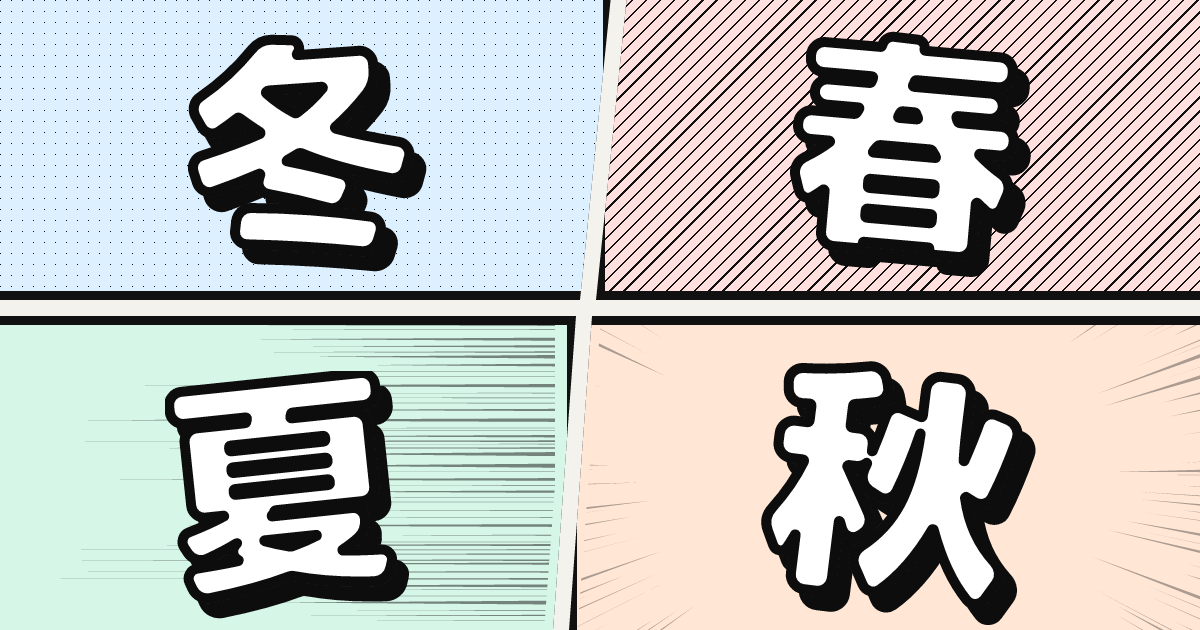
The anime year has four seasons
Japanese TV networks plan their schedules in quarters, and most new series premiere in the first weeks of one:
| Season | Months | New shows usually start |
|---|---|---|
| Winter | January – March | early January |
| Spring | April – June | early April |
| Summer | July – September | early July |
| Fall | October – December | early October |
That's why the first two weeks of January, April, July and October are so crowded, and why charts like our season chart are organised by season. A show "belongs" to the season it premieres in, even if it keeps running long after.
So what is a cour?
A cour (クール, kūru, from the French cours) is one of those three-month broadcast blocks. In practice that means about 12 or 13 weekly time slots.
- A 1-cour show runs for one season: usually 12 or 13 episodes.
- A 2-cour show runs for two seasons in a row: roughly 24 to 26 episodes.
- A split-cour show airs its first cour, takes a break of one or more seasons, then returns for the second half.
When people say a series is "getting a second cour", they mean a continuation in a later season, not necessarily a whole new season with a new title.
Why so many shows end at episode 12 or 13
Most late-night anime is funded by a production committee (several companies sharing cost and risk), which books a TV slot for a set number of weeks. A single cour is the smallest common unit, so it keeps budgets and commitments manageable. If the show sells well, a sequel can be ordered later.
Thirteen weekly slots fit in a quarter, but holidays, sports broadcasts and year-end specials often take one, so many shows land on 12 episodes.
The long-runners don't follow the rules
Some series simply never stop. Family shows like Sazae-san (on air since 1969) and Detective Conan (since 1996) run week after week through every season. Long fantasy and sports adaptations often run several cours back to back.
On NextCour these appear under Still airing from earlier seasons on the current season chart, so you can find them without digging through older seasons.
Reading Japanese air times
New anime mostly airs late at night in Japan, and Japanese TV listings keep counting past midnight: a slot written as 25:30 means 1:30 a.m. the following morning. It's still treated as part of the previous broadcast day.
Japan Standard Time (JST) is UTC+9 all year round, with no daylight saving. From the Netherlands, an episode at 23:00 JST airs at 16:00 in summer (CEST) or 15:00 in winter (CET). Our weekly schedule does this conversion for you, and lets you flip to JST if you prefer the original times.
How NextCour counts the weeks
Our cour ruler splits each season into 13 weeks, starting on the 1st of its first month. "Week 2 of 13" in early October simply means we're in the second week of the Fall cour, not that every show is on episode 2. Shows start on different days, and a few premiere a little before or after the season begins.
Quick version: four seasons a year, one cour per season, about 12 weekly episodes per cour. Two cours in a row make a 2-cour show; two cours with a gap make a split-cour.